How to Match Hanging Planters With Saucers for Drainage
Last Updated: November 21, 2026
Quick Summary
A hanging planter saucer catches the water that drains through a pot's holes, keeping decks, walls and mountings dry. To match one, measure the pot's base diameter, confirm the attachment style, and check that the saucer holds roughly 1 to 2 cups of water.
- Measure the flat base of the pot, not the rim, before choosing a saucer.
- Confirm whether the pot is drop-in, threaded, or integrated before buying a separate saucer.
- Avoid saucers more than about 2 inches wider than the pot base.
- Water slowly, wait two to three minutes, then empty the saucer.
- Anchor hanging planters to at least twice their wet weight.
Table of Contents
- Why Saucers Matter for Hanging Planters
- Check Drainage Holes Before You Buy or Hang
- How to Choose the Right Planter Saucer Size
- How to Water Hanging Plants Without Overflow
- How to Prevent Water From Dripping From Hanging Baskets
- Installing Your Matched Planter and Saucer Safely
- Pick Your Matching Planter and Saucer Set Today
- Frequently Asked Questions
Why Saucers Matter for Hanging Planters
A hanging planter with a mismatched saucer can soak a deck, stain a wall, or leave a puddle that rots the mounting. A properly matched hanging planter saucer catches the water that drains through the pot's holes and keeps your surfaces dry. The right saucer also lets excess water drain freely, so roots don't sit in standing moisture.
This guide walks through how to check drainage, size the saucer, water without overflow, and hang the set safely.
Hanging pots are the hardest containers to manage because gravity works against you. Water runs down and out of the pot, and it can land anywhere below. A saucer is not decoration. It is the part of the system that controls where the water goes.
Check Drainage Holes Before You Buy or Hang
Before you commit to a planter, confirm it has drainage holes in the base. Without them, water collects at the bottom, roots rot, and no saucer can fix the problem.
Look for these details:
- Holes in the base: Hanging planters from Beloit Plastics LLC are delivered with drainage holes.
- Hole size: Holes should be large enough for water to exit quickly but small enough that soil doesn't wash through.
- Clearance above the saucer: The planter's base should sit above the saucer rim so water can flow out instead of pooling against the bottom.
If you already own a planter without holes, drill them with a masonry or plastic bit before potting. Test the setup by watering lightly and watching the flow.
Before you buy or hang, check these details that determine how well the saucer will work.
| Check | What to look for | Why it matters |
|---|---|---|
| Holes in the base | Drainage holes present | Without them, water pools and roots rot |
| Hole size | Large enough to drain, small enough to hold soil | Quick exit without soil washing through |
| Clearance above saucer | Base sits above saucer rim | Water flows out instead of pooling |
How to Choose the Right Planter Saucer Size
Matching a saucer to a planter comes down to four checks: diameter, attachment style, capacity, and compatibility with how you water.
Check 1: Measure the Base, Not the Rim
Turn the planter upside down and measure across the flat bottom where it will contact the saucer. That base diameter, not the rim diameter, is the number that has to fit. Because the rim and base of a pot can differ in diameter, measure the base before choosing a saucer. Measure twice with a tape across the widest point of the base and write the number down before you shop.
Check 2: Confirm the Attachment Style
Saucers attach to hanging planters in three ways, and the style has to match the pot:
- Drop-in or seated saucer: The pot base rests inside a raised rim on the saucer. This is the most common removable style and the easiest to empty.
- Threaded or twist-lock saucer: The saucer screws onto the pot base. It stays put in wind but is harder to remove for cleaning.
- Integrated saucer: Molded into the pot as one piece. There is nothing to match, but you also cannot swap or replace it.
If your pot has a threaded base, a plain drop-in saucer will not seat correctly and will wobble. Confirm the attachment style from the product description or by looking at the base of the pot before you order a separate saucer.
Check 3: Match Saucer Capacity to Pot Volume
A saucer that is the right diameter but too shallow will overflow on the first thorough watering. As a working rule, the saucer's usable depth should hold roughly the volume of water that drains from a saturated pot, which for most indoor hanging pots is about 1 to 2 cups.
Check 4: Verify Compatibility With Your Watering Method
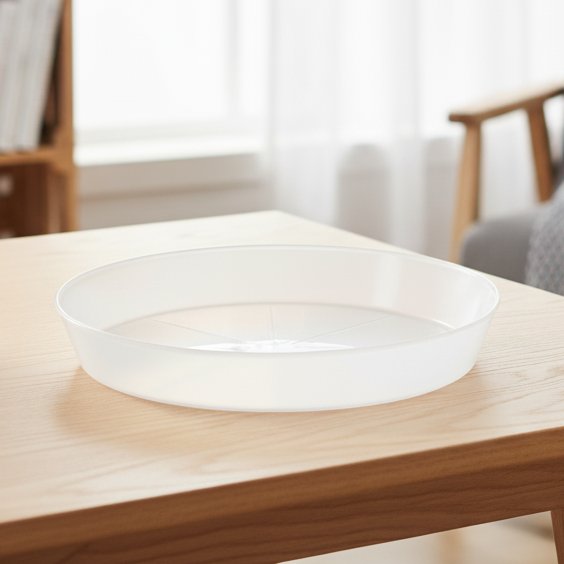
If you water at the sink and let the pot drain fully before rehanging, a shallow removable saucer is fine. If you water in place, you need a deeper saucer and a pot that sits above the saucer floor so the base is not standing in water. A saucer with a flat inner surface and a ribbed underside, like the Austin Planter 18 Inch 16 3 Inch Base Case Of 2 Plant Saucers, lets the pot rest evenly while keeping the saucer slightly off the surface below. The Austin Saucers 18in16 3in Base Clear Polypropylene Pack Of 2 gives you a removable 18-inch option you can reuse across several planters.
Watch out: A saucer that is more than about 2 inches wider than the pot base can collect water that never reaches the pot and can trap humid air against the base, which encourages mildew on the pot and the surface underneath.
Removable Versus Integrated Saucers
Removable saucers let you empty and clean the tray separately and swap them between pots. Integrated saucers keep the setup simpler but limit flexibility and cannot be replaced if they crack. For patio and balcony use, where you will empty the saucer often, removable is the better choice.
How to Water Hanging Plants Without Overflow
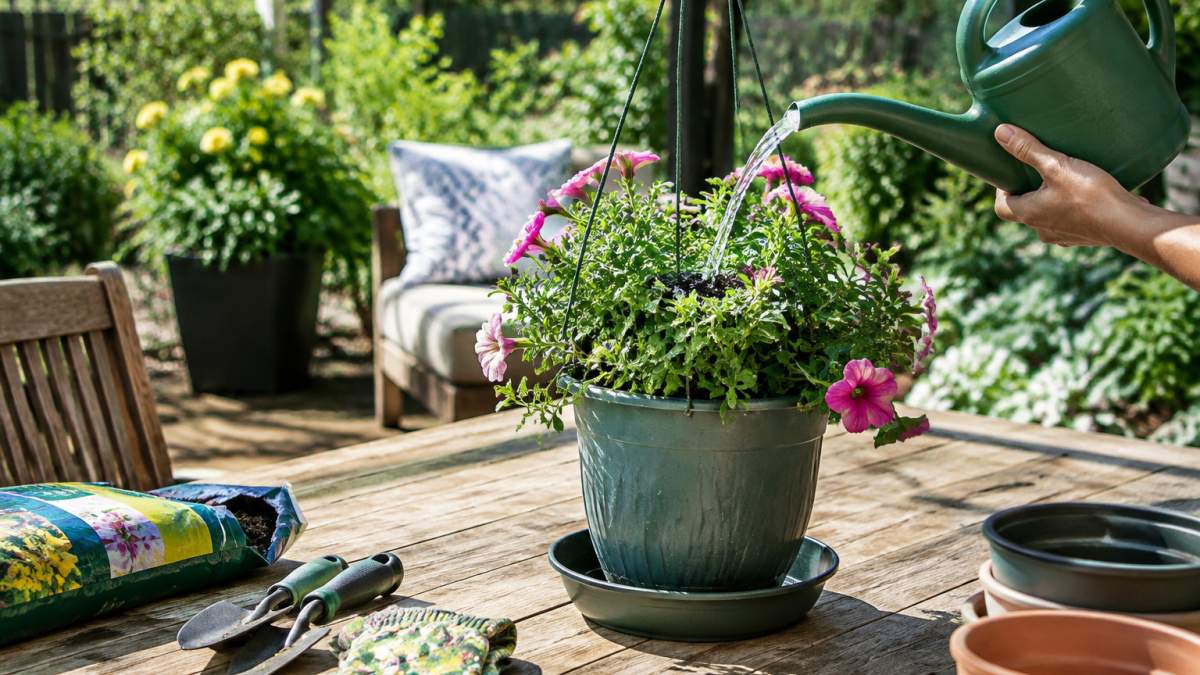
Overflow usually comes from watering too fast or too much at once. Water the soil slowly and let it drain for a minute or two before you walk away.
Follow these steps:
- Water until the first drops exit the base. If residue has built up on the saucer, see How to Remove Hard Water Stains From Planters to clean it. That signals the soil is saturated, and more water will just run out.
- Wait two to three minutes. Water still draining into the saucer means you are not finished yet.
- Empty the saucer. Standing water left in the tray can wick back into the soil and stain whatever it sits on.
- Check the saucer weekly. Mineral residue and debris can reduce drainage over time.
Water in the morning when possible so foliage can dry. Overwatering is more damaging than underwatering for most container plants, so when in doubt, wait a day.
How to Prevent Water From Dripping From Hanging Baskets
Dripping usually means the saucer is undersized, the planter is tilted, or the soil is too wet to hold water. Fix the cause rather than adding more absorbent material.
Start with these checks:
- Confirm the saucer diameter matches the base, as described above.
- Hang the planter level. A tilt sends water toward one edge.
- Use a lightweight potting mix that drains well rather than a dense garden soil.
- Reduce watering frequency when plants are not actively growing.
A matched saucer catches most drips. If water still escapes, the problem is almost always the watering method, not the hardware.
Installing Your Matched Planter and Saucer Safely
A hanging planter fails at the anchor, not at the pot. The saucer adds weight, the wet soil adds more, and the dynamic load of watering and wind adds more still. Plan for the worst-case wet weight and anchor for at least twice that.
Estimate the Wet Weight Before You Hang
Weigh the assembled pot after a thorough watering to estimate its wet weight, and allow a safety margin for wind and movement.
Choose the Right Anchor for the Surface
- Ceiling joist or beam: The strongest option. Use a lag screw or a heavy-duty ceiling hook rated for at least twice the wet weight, driven into solid wood, not just drywall.
- Drywall only: Do not hang a loaded planter from drywall alone. Use a toggle bolt rated for the load, and keep the pot small, generally under 15 pounds wet.
- Concrete or masonry: Use a sleeve anchor or a masonry screw sized for the load. Pre-drill to the anchor manufacturer's specified diameter.
- Porch beam or pergola: Use a beam clamp or a strap hanger rather than drilling into the beam, and confirm the clamp's working load limit exceeds your wet weight.
Select Hooks, Chains, and Hangers by Rating
Hooks and chains are sold with a working load limit, and that number should be at least twice your wet weight. Check that the hanger's attachment point on the pot is rated for the load you plan to hang.
Position the Saucer for Drainage and Airflow
Hang the planter level so water drains evenly into the saucer rather than running to one edge. Leave at least 2 inches of clearance between the saucer and any wall, railing, or post so air can circulate and the saucer can be lifted out for emptying. To keep mold from forming under the pot once it is hung, see how to prevent mold under garden pots before it starts. Outdoors, position the set so the saucer drains away from siding, trim, and the foundation rather than toward them.
Watch out: Inspect the hook, chain, and saucer each season, and bring removable saucers inside before the first hard freeze if the pot stays out.
Inspect and Recheck Each Season
Check for rust on chains and hooks, loosening at the anchor, cracks in the saucer rim, and any tilt in the pot. A pot that has shifted is a sign the anchor is working loose. Re-tighten or replace the hardware before the next watering, and empty the saucer before you move or rehang the set so water does not spill onto the floor or deck.
Pick Your Matching Planter and Saucer Set Today
Matching a hanging planter to its saucer comes down to three checks: drainage holes in the base, a saucer sized to the pot's base, and a hanging setup rated for wet weight. Get those right and most overflow and drip problems disappear.
Beloit Plastics LLC offers U.S.-made hanging planters and saucers. Browse the Austin Multi-Size Plastic Pots 5pcs at $13.95 for a multi-size set, or the LAP 12 inch Pot with Saucer or Hanger at $19.99 for a single pot with saucer or hanger. Start matching your set today and keep water where it belongs.
Frequently Asked Questions
Do hanging planters need drainage holes?
Yes. Drainage holes let excess water leave the pot so roots do not sit in standing water and rot. A hanging planter without drainage holes will hold water even when a saucer is attached, and the saucer will eventually overflow. Choose a planter with drainage holes, such as the Beloit Plastics SHAP 7 inch Pot with Hanger, and use a saucer to catch the runoff.
How do you match a saucer to a hanging planter?
Match the saucer diameter to the pot base or slightly larger than the base so it catches the full drip zone. The inner surface should be flat so the pot rests evenly. Beloit Plastics' LAP 12 inch Pot with Saucer or Hanger and MAP 9 inch Pot with Saucer or hanger are sold with saucers. Measure the base before buying a separate saucer.
Should a hanging planter saucer touch the bottom of the pot?
The pot should sit inside or on the saucer without wobbling, and the saucer should collect water from the drainage holes. Ribbed or support-grid saucers keep the planter slightly above the bottom surface so air can circulate and moisture does not stay trapped. Check that the pot does not block the drainage holes when it rests on the saucer.
How often should you empty a hanging planter saucer?
Empty the saucer after each watering once it has collected water, and do not let it sit full for long. Standing water in a saucer can lead to root rot and mosquito breeding. During rainy periods, check the saucer more often because rain can fill it without any watering at all.

